The Space Between Ideas and Finished Projects: Why Your Workshop Setup Is Holding You Back
There's a moment most makers know well. You've got a killer idea, the materials are somewhere in the garage, the tools are probably in that bin — or was it the shelf? — and by the time you've spent twenty minutes hunting for a single drill bit, the energy is gone. The project gets shelved. Again.
It's easy to blame motivation or time. But increasingly, researchers and experienced makers alike are pointing at something more concrete: the physical environment where you work.
Your space isn't neutral. It's either working for you or against you, and most of the time, it's quietly doing the latter.
What the Research Actually Says
Environmental psychology has spent decades studying how physical spaces affect cognitive performance, mood, and creative output. A widely cited study out of the University of Minnesota found that cluttered environments can actually stimulate creative thinking in short bursts — but here's the catch. That same clutter tanks follow-through. You might get a flash of inspiration in a messy room, but you're far less likely to see the project through to completion.
Separate research from Princeton's Neuroscience Institute found that physical disorder competes for your brain's attention, reducing your ability to focus and process information efficiently. Translation: every pile of unsorted components on your workbench is literally pulling mental bandwidth away from what you're trying to build.
For makers — people who depend on sustained creative focus across hours or even days — this stuff matters. A lot.
Real Makers, Real Consequences
Ask around any makerspace or online maker community and you'll hear the same story told a dozen different ways.
Jamila, a leather crafter based in Atlanta, described her first dedicated workspace as "organized chaos that was really just chaos." She was working out of a spare bedroom with supplies stacked on every surface. "I'd start something and then stop because I couldn't find what I needed, and then I'd lose the thread of what I was even doing. Projects sat half-done for months."
After reorganizing — not remodeling, just reorganizing — she says her project completion rate changed dramatically. "I finished four bags in the month after I sorted out my space. I hadn't finished four in the previous six months."
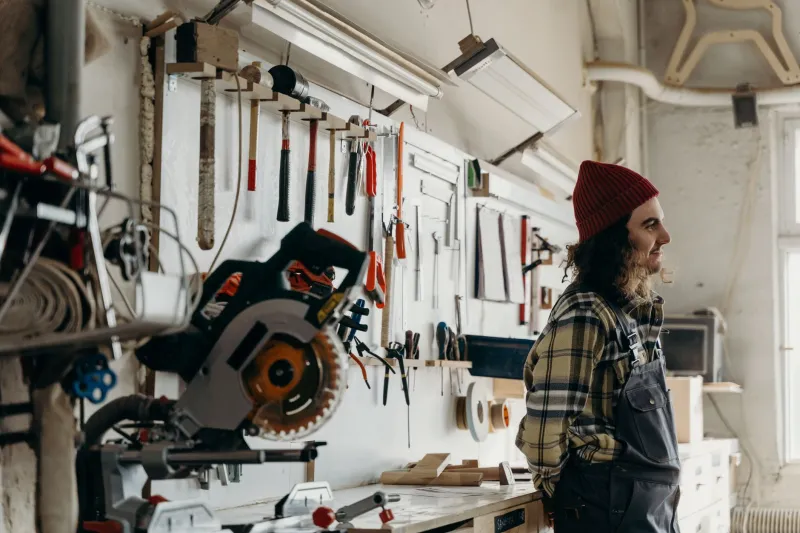
Marcus, a woodworker in Portland, Oregon, had a different problem: a great layout but terrible lighting. "I was making mistakes I couldn't explain. Wrong cuts, bad joints. Turned out I literally couldn't see what I was doing properly." A couple of LED shop lights later, his scrap pile shrank significantly.
These aren't edge cases. They're the norm.
The Psychology of the "Launch Zone"
One concept that's gained traction in maker communities is the idea of a "launch zone" — a dedicated, always-clear area right in front of you when you sit or stand at your bench. This is the active workspace, kept free of everything except the current project and the tools immediately needed for it.
The principle borrows from behavioral design: the easier you make it to start, the more likely you are to start. And starting is half the battle.
Think of it like mise en place in cooking. Professional chefs don't hunt for the salt mid-recipe. Everything is prepped and placed before the work begins. Applying that same logic to your shop — even just for the first fifteen minutes of a session — can dramatically reduce friction.
Low-Cost Hacks That Actually Work
You don't need to renovate your garage or drop serious money on custom cabinetry. Most of the highest-impact workspace changes cost next to nothing.
1. The One-In, One-Out Surface Rule Choose one surface as your active workspace and commit to keeping it clear at the end of every session. Everything gets put away before you leave the room. It feels tedious until it becomes habit, and then it feels essential.
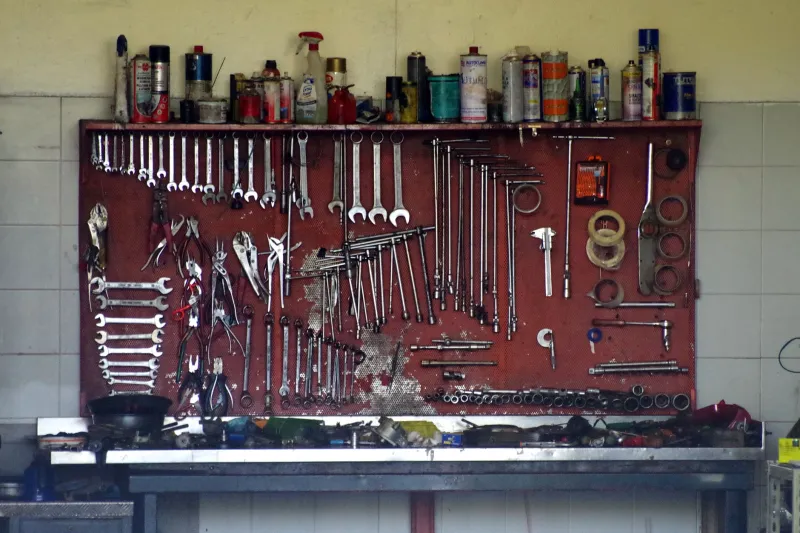
2. Pegboards Are Underrated A sheet of pegboard from your local hardware store runs about $15–$25. Mount it, grab a bag of hooks, and suddenly your most-used tools are visible and reachable in seconds. Visibility matters — if you can see a tool, you'll use it. If it's buried in a drawer, you'll forget you own it.
3. Label Everything (Seriously) A basic label maker or even hand-written masking tape labels on bins and drawers removes the mental tax of remembering where things live. It sounds almost embarrassingly simple, but it works.
4. Light Like You Mean It Natural light is ideal, but most garages and basements don't have enough of it. Daylight-spectrum LED shop lights (look for 5000K color temperature) run $30–$60 each and transform how you see your work. Don't underestimate this one.
5. Zone Your Space by Activity Even in a small area, designating zones — one for cutting, one for assembly, one for finishing — reduces the mental overhead of transitioning between tasks. Physical cues tell your brain what mode to be in.
6. Keep a Project Notebook at the Bench Not on your phone. A physical notebook. When you have to stop mid-project, jot down exactly where you are and what the next step is. Returning to a project is infinitely easier when you don't have to reconstruct your own thought process from scratch.
7. Tackle the Floor First Floor clutter is a safety hazard and a psychological weight. A clear floor makes a space feel more functional and more professional, even if the shelves are still a work in progress. Start there.
8. The "Tomorrow Box" Keep a small bin or tray where you set out the materials and tools for your next session before you leave. It's a low-friction way to guarantee a fast start next time.
Start Small, Then Build
The temptation when tackling a workspace overhaul is to wait until you have time to do it all at once. That day rarely comes. Instead, try the "fifteen-minute rule": spend the last fifteen minutes of every making session doing one small organizational task. Move one pile. Label one bin. Clear one shelf.
Over a few weeks, the cumulative effect is significant — and you'll never have to blow a whole Saturday on a dreaded cleanup session.
Your workspace is a tool just like any other in your shop. A poorly maintained tool produces poor results. A well-tuned one helps you do your best work.
So before you blame the project, blame the bench. Then fix the bench. Your ideas deserve a space that's actually ready for them.