Who Taught You That? How Real Makers Find the Mentors Who Change Everything

Ask any experienced woodworker, electronics tinkerer, or textile artist how they got good, and you'll almost always hear the same kind of answer. It wasn't a YouTube channel. It wasn't a community college course. It was a person — someone who let them pull up a stool, make a mess, and ask dumb questions until things started clicking.
Mentorship has always lived at the heart of maker culture, even when nobody was calling it that. The DIY world runs on a kind of informal knowledge economy where skills get passed sideways as often as they get passed down, and where the most valuable lessons rarely come with a syllabus.
So how do you actually find that person? And if you're the one with the skills, how do you become the mentor you wish you'd had?
The Unwritten Code of Maker Knowledge-Sharing
There's a quiet ethic that runs through most healthy maker communities: you share what you know. It's not altruism exactly — it's more like a cultural agreement. The maker who taught you how to dial in your CNC router probably learned from someone else, who learned from someone else before that. You're part of a chain, and the expectation is that you'll add a link someday.
But that ethic doesn't mean everyone is automatically open to being someone's full-time teacher. Time is real. Projects are demanding. And showing up to a makerspace and announcing that you want to learn everything from the first person you see is a reliable way to get politely avoided.
The unwritten rule? Earn the conversation before you ask for the education. Help clean up. Offer to assist on someone else's project. Be genuinely curious about what other people are building before you talk about what you want to build. In most maker communities, interest and generosity are the currencies that open doors.
Where Mentor Relationships Actually Happen
Forget the idea that mentorship requires a formal arrangement. Some of the most transformative maker relationships in the country started with something as simple as a comment on a forum post or a question asked across a workbench.
Makerspaces and hackerspaces are still the most reliable places to find experienced creators who are already in the habit of sharing. Many spaces have open shop nights specifically designed for this kind of organic exchange. Show up consistently, and you'll start to notice who the real veterans are — they're usually the ones who get asked questions by everyone else.
Craft fairs and maker markets are underrated networking opportunities. Vendors at these events have usually been doing their thing long enough to have real opinions and hard-won knowledge. A genuine compliment about someone's work, followed by a thoughtful question about their process, can open a conversation that leads somewhere meaningful.
Online communities — particularly niche subreddits, Discord servers, and Facebook groups organized around specific crafts — are where a lot of modern maker mentorship quietly happens. A relationship that starts with someone patiently answering your questions in a thread can evolve into DMs, video calls, and eventually real collaboration. Don't underestimate how far genuine engagement in these spaces can take you.
Local guild chapters for everything from blacksmithing to quilting to amateur radio still exist in most mid-sized American cities, and they tend to skew toward experienced practitioners who actively want to pass things on. These groups are goldmines for anyone willing to show up in person.
What Good Mentorship Actually Looks Like
It's not a weekly appointment. It's not structured homework. In the maker world, mentorship usually looks like access — access to someone's process, their thinking, their mistakes, and their hard-won shortcuts.
Marcus, a furniture maker based in Asheville, North Carolina, describes the relationship that shaped his work: "I used to just hang around this older guy's shop on weekends. He never sat me down and taught me anything formally. But I watched him problem-solve in real time, and I started to understand how he thought about wood. That was worth more than any class."
That kind of observational learning — what researchers sometimes call legitimate peripheral participation — is deeply embedded in craft traditions. You absorb not just techniques but judgment, which is the thing that's almost impossible to teach directly.
For the mentee, the practical advice is simple: be useful, be consistent, and be patient. Don't show up once and expect transformation. Show up enough times that someone starts to know your name and trust your intentions.
If You're the One With the Skills
Seasoned makers sometimes hesitate to take on a mentee role because it sounds like a lot of work. And it can be, if you're trying to structure it like a class. But it doesn't have to be that.
The lowest-friction version of mentorship is simply being open. Answer questions when they come. Let someone watch you work. Explain your reasoning out loud while you're doing something difficult. Post your process, not just your finished pieces. These small acts of transparency add up.
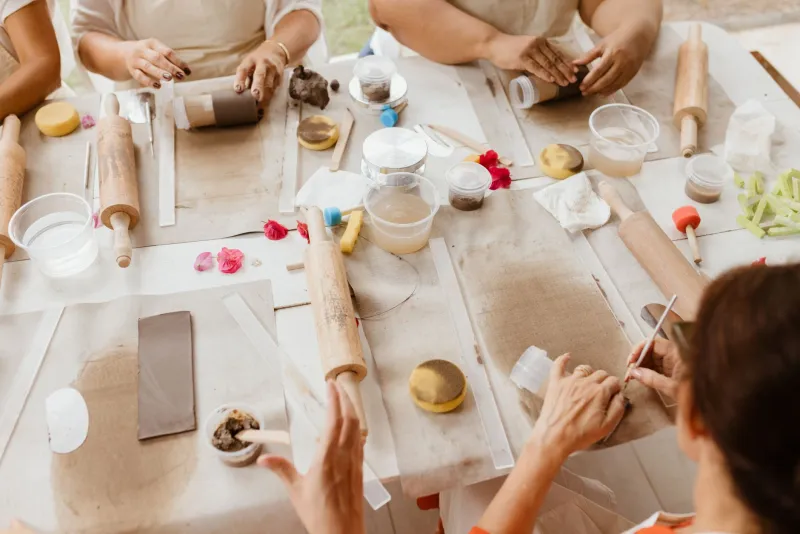
If you want something more intentional, consider hosting a small workshop out of your studio, even informally. Invite two or three people who've expressed interest in what you do. You'll almost certainly learn something yourself — teaching has a way of surfacing assumptions you didn't know you were making.
The maker community grows when knowledge flows. And the reputation you build as someone who gives generously tends to come back around in ways you don't always expect — collaborations, referrals, friendships that outlast any single project.
Finding Your Match Without the Awkwardness
If you're newer to making and actively looking for guidance, here's a practical approach that actually works:
-
Be specific about what you want to learn. "I want to get better at metalworking" is vague. "I'm trying to understand how to properly set up a TIG welder for thin gauge steel" gives someone something concrete to help with — and signals that you've already done some thinking.
-
Start with a small ask. Don't lead with a request for ongoing mentorship. Ask one good question. See how that goes. Build from there.
-
Document and share your progress. When someone helps you, show them what you did with it. Post your results. Tag them. Nothing motivates a mentor like seeing that their time made a real difference.
-
Offer something in return. Even if your skills are limited, you have something to contribute — labor, a fresh perspective, help with photography or social media, or just genuine enthusiasm. The relationship works better when it flows both ways.
The maker community isn't a ladder where knowledge only flows downward. It's more like a web — interconnected, resilient, and built on the simple idea that what you know becomes more valuable when you share it. Find your place in that web, and don't be surprised when it holds you up.